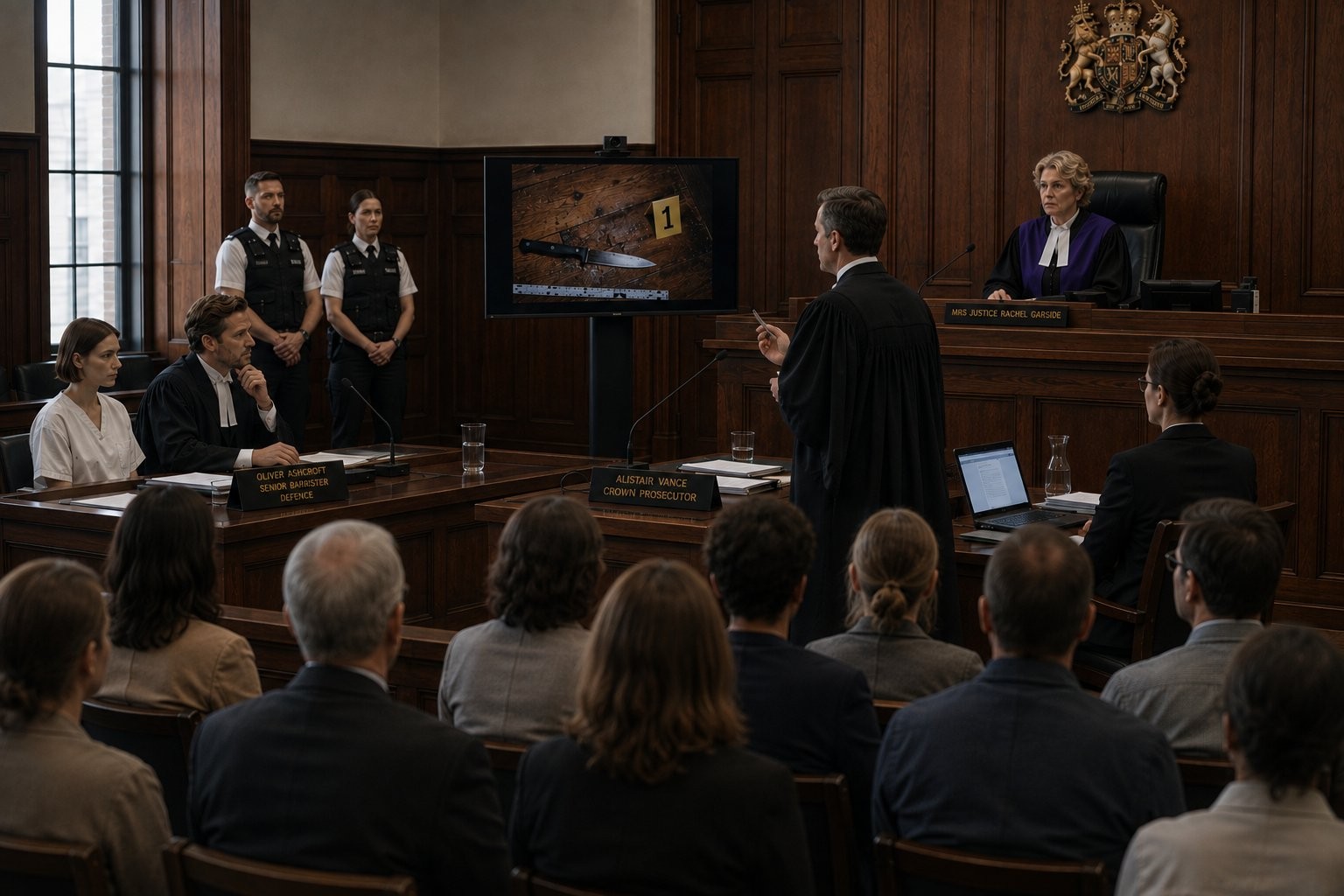
The Old Bailey, London -
The murder trial of Beatrice Halloway is set to enter its second week, following four days of testimony from Detectives and Forensic Experts that took the stand this week. The first full day of the trial featured testimony from Detective Chief Inspector Eleanor Whitmore in the morning and testimony from Detective Sergeant Nathan Mercer.
While on the stand, Inspector Whitmore outlined the entire timeline of the investigation, from the time the 999 call was made, until the trial started. Photo copies of the search warrants and arrest warrant were shown as well official documents showing witness interview transcripts.
The crux of Inspector Whitmore’s testimony was based around the decision to focus on Beatrice Halloway as the primary murder suspect.
Quoting Inspector Whitmore, “It became clear quickly, that based on what the evidence was telling us in those first few crucial days, that there was ever only one true suspect to this case.”
The defense quickly tried to undermine the prosecution's attempt at painting Ms. Halloway as the obvious killer.
While being cross examined by Mr. Ashcroft of the defense, Inspector Whitmore appeared to get slightly flustered with Mr. Ashcroft strategy of labeling the Investigation as “sloppy” and “lazy”, and that the Inspectors “Simply labeled Ms. Halloway as the suspect out of pure convenience.”
After the lunch recess, came the testimony of Detective Sergeant Nathan Mercer. The prosecution largely focused on having Sergeant Mercer give commentary to the timeline reconstruction. This was a long and tedious process that lasted several hours, leaving the defense only a few minutes for cross examination before sending the jury home for the day. While the subject matter of the timeline reconstruction wasn’t of note, it was a key step by the prosecutors to keep their argument in the forefront of the jury’s mind for as long as possible.
But, Mr. Ashcroft, ever the wily and guileful litigator, used his sparse minutes to deal a potentially heavy blow to Sergeant Mercer’s testimony. Using hard copy records of the statements made by witnesses to Sergeant Mercer, Mr. Ashcroft highlighted several continuity errors in which Sergeant Mercer mixed up witnesses on the official records.
While this could be nothing more than a simple clerical error on the part of an overworked Sergeant working the midnight shift, it does cast doubt in the minds of the jurors into the validity of Sergeant Mercer’s work ethic. Mr. Ashcroft ended his cross with a simple rhetorical question more so directed at the jury than at Sergeant Mercer himself, “If you can make such easy mistakes on a simple form and not bother to check your own work, what else have you gotten wrong in this or other investigations?”
The following day of the trial featured a shift from the direct investigation, into the forensic experts that included Sarah Pembroke, a lead crime scene photographer, as well as overseeing evidence collection and documentation, while Dr. Amelia Finch followed afterwards. Dr. Finch is a licensed forensic pathologist, and is the one who performed the autopsy on Mr. Glover.
While Ms. Pembroke’s testimony covered several facets of the criminal investigation; it was the cross examination by Mr. Ashcroft, that drew the most compelling argument for self defense yet.
“Ms. Pembroke, you acknowledge in your testimony that most of the furniture in the room where Mr. Glover was killed, was either overturned or damaged in some way. Would, in your expert opinion, that indicate that a struggle took place? And if a struggle did take place, that would indicate that his killing wasn’t a brutal one-sided attack as the prosecution has indicated?”
Ms. Pembroke gave a very by the numbers answer, stating that she “wasn’t inclined to give her opinion on what may or may not have happened in the room that night. The evidence tells the story, she just records the story.” Mr. Ashcroft then posed one final question to Ms. Pembroke. “Well in that case, Ms Pembroke, in a story of a brutal, one sided attack, does the story end with a thoroughly destroyed room and a body, or just a body?” Ms. Pembroke reluctantly testified that, “In her experience, the evidence points to a struggle and possible self-defense, rather than a one-sided attack.
It was at this revelation that Mr. Vance raised his first objection of the trial, claiming that “Ms. Pembroke’s opinion has no bearing on the facts of the case. But his objection was quickly struck down, with Mrs. Justice Garside affirming that “Ms. Pembroke’s opinion in this specific circumstance is very much considered expert testimony based upon her own previous testimony in this case.’’
After the lunch recess, the jury heard testimony from Dr. Amelia Finch, the Home Office forensic pathologist who performed the post-mortem autopsy on Mr. Glover. Dr. Finch testified that Mr. Glover did in fact die from a single stab wound to the chest that penetrated his heart. “Dead within seconds. Absolutely.” Dr. Finch answered when asked by the prosecutor whether it was fatal and if it was a serious wound. Dr. Finch also gave testimony the condition of Mr. Glover’s body upon post-mortem examination.
“Minor bruising that was sustained before death. Largely on the hands, lower forearms and face. But these were sustained days before his death, not hours or minutes. The post-mortem examination showed the bruises nearly healed and largely faded in coloration.” Mr. Ashcroft attempted to mount an objection to this testimony, but was quickly struck down and found himself cornered in his own defense strategy.
Quoting Mrs. Justice Garside on Mr. Ashcroft’s objection to the relevancy of these bruises to Mr. Glover’s body, Justice Garside reminded Mr. Ashcroft “he introduced the argument of a physical alteration between Ms. Halloway and Mr. Glover and that Dr. Finch’s observations in the post-mortem examination were of complete relevance due to this argument.”
Day four featured three experts giving their testimonies. First up was Dr. Michael Trent, an expert in bloodstain pattern analysis. Following Dr. Trent was Dr. Gareth Holloway who specializes in DNA evidence. Finally, Ms. Emily Carter took the stand to give testimony on the Digital and CCTV evidence in the case.
“The most significant aspect, that I can comment on, is that, when it comes to knife wounds, whether or not the blade has been removed from the wound carries enough weight to almost single handedly point to who was holding the blade or not. In this instance, when Mr. Glover was stabbed, he was stabbed from the front, and the blade was pulled from his chest. As a result, for the few seconds he was left alive, his heart continued to beat, albeit very erratically. This resulted in what is known as “Arterial spray” or better known as a “Blood spurt”.
“When the knife was pulled from Mr. Glover’s heart, his blood was shot out of the hole in his chest. The knife wound was a horizontal line, so the blood spray followed the path of least resistance and followed this horizontal line. As such when we examine the photo of the wall Mr. Glover was presumed to be facing when he was stabbed, we can see a clear line of blood, in a horizontal path. But, crucially, we can also see a gap in the line of blood. Something blocked the blood from traversing a complete line across the wall.”
While this testimony by Dr. Michael Trent, an expert in bloodstain pattern analysis, may not have been as stunning or revolutionary as one might expect in a high profile murder case, it was the answer to the next question by Crown Prosecutor Vance that seemed to send a profound chill across the courtroom. “You said, “Something blocked the blood” Dr. Trent. Based on this photograph of the shirt Ms. Halloway was wearing the night she was arrested, which is confirmed to have been stained by Mr. Glover’s blood, could you say whether or not the “something” you indicated, was in fact Ms. Halloway standing in front of the dying James Glover?”
“Based on the approximate thickness of the line of blood on this shirt, and the verification it is indeed Mr. Glover’s blood, I would have to conclusively state for the record, that it is Ms. Halloway standing in front of Mr. Glover. Additionally, based on the amount of blood that appears to have soaked into the shirt, I would estimate she was standing within 30 centimeters of Mr. Glover.” Mr. Vance posed one final, albeit rhetorical question to Dr. Trent, “30 centimeters is well within stabbing distance, to effectively penetrate the heart of a man.”
Mr. Ashcroft immediately objected to the question, posing relevance to Dr. Trent’s speciality, which Justice Garside sustained, but the damage had already been done. At this point in the trial, barely a week old, Ms. Halloway’s fate seemed dimmer and dimmer. But, as any savvy Crown Prosecutor would do, Mr. Vance continued to pile on with the remaining two experts slated to testify.
Friday featured the return of Ms. Carter for cross examination and finished off with Professor Henry Aldridge who is an expert in Fingerprint analysis and trace evidence gathering and processing. After the testimony of Professor Aldridge, Mrs. Justice Garside ended the day early and scheduled the trial to resume after the weekend, with Eyewitnesses and Character Statements from relatives of the defendant slated for several days as well as leaving room for expert witnesses to be called back for further cross examination.
The second expert of the day, Dr. Gareth Holloway, is an expert in DNA Evidence. Much of Dr. Holloway’s testimony focused on the process of determining that it was indeed Mr. Glover’s blood on the shirt of Beatrice Halloway, and the analysis of any material under Ms. Halloway’s nails, taken during the early hours of the investigation.
“So, Dr. Holloway, we have already introduced into evidence your verification of Mr. Glover’s blood on the defendant’s shift. Could you explain to the court how you were able to do so?” Dr. Holloway took a sip of his water before answering. “I could give you a very lecture based, overly complicated explanation, that almost certainly would confuse most everyone in the court, so I’ll simplify.’’
“White blood cells. White blood cells carry our DNA, whereas red blood cells do not. We are able to compare the DNA strands in the white blood cells found on the shirt to those taken directly from Mr. Glover’s body.” Dr. Holloway explained. “And they matched?” Mr. Vance posed to Dr. Holloway. “Yes. Obviously there is a margin of error with DNA matching, but the two DNA strands met the criteria. The two samples are for a fact Mr. Glover’s blood.”
Mr. Vance then questioned Dr. Holloway about the scrapings taken from underneath the defendant’s fingernails and asked if any DNA samples were found that belonged to the victim. “Did you find any DNA belonging to the victim under Ms. Halloway’s finger nails?” Mr. Vance asked. “No. While there were other substances under nails, none of it had Mr. Glover’s DNA.”
The crown prosecutor then posed a question to the jury following this revelation.
“If there was a struggle, a physical altercation between these two people, why was there nothing from the victim under her nails? DId she not attempt to stop him? Did she not fight, scratch and claw at him in an attempt to get away from him? The lack of this evidence points to the obvious conclusion that there was no altercation and that Beatrice Halloway killed James Glover when he wasn’t expecting it.”
During cross, the defense tried to cast some level of doubt on the validity of the DNA samples, but focusing on what Dr. Holloway said about the margin of error with DNA matching. But to the defense team's dismay, Dr. Holloway was able to clarify that the margin of error was solely within the machines used. He further clarified that the stated margin of error was within a ten thousandth of a percentage point, and that the only cases of DNA matching being incorrect have been due to rare medical conditions that make DNA matching more difficult.
With only an hour left in the day, Emily Carter, an expert in Digital and CCTV evidence took the stand. Mrs. Carter’s testimony largely featured the explanation of how they were able to use Ms. Halloway’s phone and the nearby cell towers to follow her footsteps in the hours and minutes leading up to the stabbing of Mr. Glover.
Data records showed Ms. Halloway entered Mr. Glover’s home several hours before the time of the killing. Those same records also showed Ms. Halloway made several internet searches regarding “stabbings” “where is the best place to stab the heart” “how long does it take for someone to die after being stabbed in the heart”.
Justice Garside ended the day with the Crown Prosecutor stacking up yet another massive blow to the defense. But with the final expert witness yet to testify being an expert in Fingerprint analysis, one can only assume that the Crown has saved their most damning piece of evidence, in a trial already leaning heavily against the Defense.
The cross examination of Mrs. Carter was over in minutes, with Mr. Ashcroft seemingly moved into damage control instead of outright fighting the prosecution at every turn. It is worth noting that the defendant has maintained a very neutral expression, even during the most damning testimonials against her case. Either she has accepted that she is likely to be convicted or has a brilliant poker face, and knows her defense team has an ace in the hole waiting.
The final expert witness took the stand, Professor Henry Aldridge, an expert in Fingerprint analysis and trace evidence. Professor Aldridge’s expertise in the former was the centerpiece of his testimony, with a quick but thorough explanation into how Fingerprints are analyzed and compared, followed by photographic evidence of the knife at the scene of the crime, with finger print dust covered on the handle.
Professor Aldridge showed a side by side comparison of the real knife, and the 3d scan of the knife with the layers of finger prints covered on the handle. He took the jury step by step in the process of what he called “peeling back the layers” of fingerprint analysis, showing each unique fingerprint.
Finally he showed the comparisons of each unique person’s fingerprint found on the knife handle, with their own fingerprint records, and the rough order in which each person handled the knife. Notably, he ended the demonstration with showing that Ms. Halloway’s fingerprints were the last set to grab the knife, with hers being the most recent fingerprints.
Following the conclusion of Professor Aldridge’s testimony, Mrs. Justice Garside ended the day with a recess to lunch and an order to resume the trial on Monday morning. The defendant could be seen speaking with Mr. Ashcroft quietly for a few moments before being remanded back into custody.
Mr. Vance spoke with the reporter pool outside The Old Bailey, confident and steadfast in his assurance that Ms. Halloway “was guilty beyond measure” and that “The Crown’s Justice will have its day, and Ms. Halloway will pay dearly.”
Mr. Ashcroft had no comment as he left the building.
I’m Kelly Chamber’s with News Now, keeping you up to date on the Murder Trial of Beatrice Halloway.