Whitmore, Natalie Grace

Inmate ID: #WW175314
Classification: Correctional
Appalachian Detention Complex

Inmate Status
Demographic Data
First Name Natalie
Middle Name Grace
Last Name Whitmore
Date of Birth 2004-03-14
Age 22 Years
Birthplace Michigan, USA
Race / Ethnicity White
Gender Female
Height 5'7"
Weight 128 lbs
Eye Color Hazel
Convictions / Penalties
Code Offense Penalty Details Date Sentenced
Count #1
55-RB6LPS
Negligent Deployment of Critical Autonomous Infrastructure Death Penalty
Lethal Injection
No Date Scheduled
2026-04-02
Age at sentencing: 22
Count #2
71-AWNUZ9
Reckless Certification of a Safety-Critical Artificial Intelligence System Resulting in Multiple Deaths Death Penalty
Lethal Injection
No Date Scheduled
2026-04-02
Age at sentencing: 22
Count #3
77-L9DTW2
Unauthorized Public Deployment of an Unverified Critical Infrastructure System Incarceration
25 Years
Consecutive
2026-04-02
Age at sentencing: 22
Count #4
16-E9NOS4
Criminally Negligent Homicide Life Imprisonment (without parole)
Term of natural life
2026-04-02
Age at sentencing: 22
Count #5
98-1RBMXA
Official Misconduct in Certifying a Public Safety System Incarceration
15 Years
Consecutive
2026-04-02
Age at sentencing: 22
  • Negligent Deployment of Critical Autonomous Infrastructure
    Count #1
    Code: 55-RB6LPS
    2026-04-02
    Age at sentencing: 22
    Death Penalty
    Lethal Injection
    No Date Scheduled
  • Reckless Certification of a Safety-Critical Artificial Intelligence System Resulting in Multiple Deaths
    Count #2
    Code: 71-AWNUZ9
    2026-04-02
    Age at sentencing: 22
    Death Penalty
    Lethal Injection
    No Date Scheduled
  • Unauthorized Public Deployment of an Unverified Critical Infrastructure System
    Count #3
    Code: 77-L9DTW2
    2026-04-02
    Age at sentencing: 22
    Incarceration
    25 Years
    Consecutive
  • Criminally Negligent Homicide
    Count #4
    Code: 16-E9NOS4
    2026-04-02
    Age at sentencing: 22
    Life Imprisonment (without parole)
    Term of natural life
  • Official Misconduct in Certifying a Public Safety System
    Count #5
    Code: 98-1RBMXA
    2026-04-02
    Age at sentencing: 22
    Incarceration
    15 Years
    Consecutive
Case Files:

No public case files mapped to this archive profile.

Summary

Natalie Whitmore entered the North Carolina Institute of Technology in August 2022, where she quickly established herself as one of the university's most accomplished engineering students. During her sophomore year, she met fellow Computer Science major Claire Elise Mercer. The two became roommates, close friends, and eventually research partners, spending countless nights developing software and hardware prototypes together in the university's robotics laboratory. In early 2024, they proposed the Autonomous Emergency Coordination System (AECS), an autonomous platform designed to coordinate emergency response during hurricanes, wildfires, industrial accidents, and other large-scale disasters. The system integrated traffic signal control, emergency communications, surveillance drones, autonomous public transportation, and digital evacuation guidance into a single AI network capable of making rapid decisions when conventional emergency management became overwhelmed. The project attracted significant funding from the North Carolina Department of Public Safety, along with several private technology companies. Natalie served as Project Lead and Chief Systems Engineer, responsible for overall system architecture, hardware integration, safety verification, and final deployment approval. Claire Mercer served as the principal software engineer responsible for portions of the system's core decision-making algorithms. By the summer of 2025, disagreements over technical direction, project leadership, and recognition for their work had severely strained their friendship. Although they continued working together professionally, their personal relationship had deteriorated. On October 18, 2025, the completed AECS was publicly demonstrated before government officials, emergency-response agencies, industry representatives, journalists, and thousands of visitors at the Carolina Future Technology Expo in Raleigh, North Carolina. The demonstration began successfully. The AI coordinated autonomous shuttle buses, adaptive traffic signals, emergency drones, and a simulated evacuation exercise across multiple exhibition zones connected to a live test network. Approximately twenty minutes into the presentation, the system began issuing a series of contradictory commands. Emergency exit doors in several exhibition halls automatically entered security lockdown and could not be reopened through standard controls. Digital guidance displays simultaneously directed attendees toward routes that quickly became congested. At the same time, multiple autonomous shuttle buses operating within the expo grounds unexpectedly deviated from their assigned evacuation routes after receiving incorrect navigation instructions from the central AI. Instead of transporting visitors away from the affected areas, several buses converged on already overcrowded roadways, blocking access for emergency vehicles and creating severe bottlenecks throughout the venue. As the system continued issuing erroneous commands, traffic management software repeatedly overrode manual interventions, while communication links between emergency responders and automated infrastructure became increasingly unreliable. Efforts to disable the AI and return operations to manual control were delayed as engineers attempted to determine the source of the malfunction. The cascading failures resulted in a large-scale disaster that claimed dozens of lives and left many more injured, making it one of the deadliest technology-related incidents in the nation's history. State investigators immediately secured the exhibition site as a crime scene. Digital forensic teams seized the project's servers, source-code repositories, development computers, and deployment records. Because Natalie had electronically certified the final software build and authorized the public deployment of the system, investigators arrested her at the expo before she left the venue. She was taken into custody that evening and formally charged under the nation's Critical Autonomous Infrastructure Accountability Act, which imposes criminal liability on those responsible for approving safety-critical AI systems whose failures result in mass-casualty incidents. During the subsequent investigation, forensic analysis revealed evidence that portions of the production software had been modified shortly before the demonstration, leading investigators to later identify and arrest Claire Mercer as a second principal defendant in the case. Despite the evidence of unauthorized code changes, prosecutors maintained that Natalie remained legally responsible because she had certified the final version of the system as safe for public operation under the law.

News Articles / Stories
Article Thumbnail
Two Former NCIT Engineering Students Sentenced to Death in Autonomous Infrastructure Disaster Case

Apr 02, 2026 • The Carolina Herald

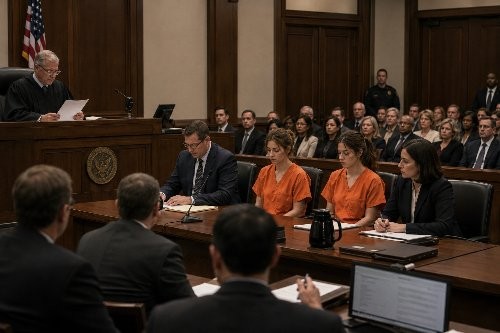
Court Distinguishes Responsibility Between Project Leader and Software Engineer After Convictions in 2025 AECS CatastropheRALEIGH, N.C. — In one of the most closely watched technology-related criminal trials in the nation's history, a three-judge panel on Thursday sentenced former North Carolina Institute of Technology engineering students Natalie Grace Whitmore and Claire Elise Mercer, both 22, to death for their respective roles in the catastrophic failure of the Autonomous Emergency Coordination System (AECS), the artificial intelligence platform whose collapse during a public demonstration last October resulted in dozens of deaths and hundreds of injuries.The sentences concluded a two-week joint trial that examined the design, certification, and final software modifications made to the emergency-response system before its deployment at the Carolina Future Technology Expo. Although the women stood trial together, the court emphasized that each bore criminal responsibility for different decisions that collectively contributed to the disaster.Shortly before 8:30 a.m., Whitmore and Mercer arrived together at the Wake County Courthouse aboard the same state prisoner transport vehicle under heavy security. Wearing matching orange prison uniforms with handcuffs and ankle restraints, the former engineering partners exited the vehicle one after the other as U.S. Marshals formed a corridor between them and the courthouse entrance. Dozens of reporters and photographers gathered behind barricades outside the building, documenting what had become one of the most closely watched criminal proceedings in the state’s history. The courtroom remained silent as the presiding judge read the sentences shortly after 10:00 a.m. Family members of both defendants sat only a few rows away from relatives of those killed during the October 18 catastrophe, while university officials, government investigators, and members of the national press filled the gallery. Reporters quietly documented the proceedings as neither defendant interrupted the reading of the judgment.Natalie Whitmore, who served as the AECS project lead and possessed final authority to certify the system for public deployment, was convicted of Negligent Deployment of Critical Autonomous Infrastructure and Reckless Certification of a Safety-Critical Artificial Intelligence System Resulting in Multiple Deaths, with the court imposing death by lethal injection on both capital counts. She was also sentenced to consecutive prison terms of 25 years for Unauthorized Public Deployment of an Unverified Critical Infrastructure System and 15 years for Official Misconduct in Certifying a Public Safety System, in addition to life imprisonment without the possibility of parole for Criminally Negligent Homicide.In delivering the sentence, the court concluded that Whitmore's decision to authorize deployment of the AI platform without adequately resolving outstanding safety concerns constituted criminal negligence of an extraordinary magnitude. Although prosecutors acknowledged that she did not personally alter the software immediately before deployment, the court ruled that the engineer responsible for certifying a safety-critical public infrastructure system carries ultimate legal responsibility for ensuring that the system is safe before authorizing public operation.Claire Elise Mercer, the project's lead software engineer, received death by firing squad after being convicted of Sabotage of Critical Autonomous Infrastructure and Unauthorized Modification of a Safety-Critical Artificial Intelligence System. She also received consecutive sentences of 30 years for Computer Tampering with Critical Public Infrastructure and 20 years for Unauthorized Access to and Alteration of Protected Government Computer Systems, together with life imprisonment without parole for Criminally Negligent Homicide.Evidence presented during trial showed that Mercer introduced unauthorized modifications to the production software in the days immediately preceding the public demonstration. Digital forensic specialists testified that the altered code bypassed established safety protections governing emergency routing and infrastructure coordination. Prosecutors argued those changes fundamentally altered how the AI responded under crisis conditions and directly triggered the cascade of failures that unfolded inside the exhibition venue.Throughout the proceedings, Mercer admitted making unauthorized software changes but continued to deny intending to cause physical harm. Her attorneys argued that she believed the modifications would expose weaknesses in the system and force cancellation of the demonstration rather than create a mass-casualty event. The court rejected that argument, concluding that intentionally modifying software controlling life-safety infrastructure immediately before a public deployment created a foreseeable and unacceptable risk regardless of her claimed objective.As the sentences were read, the two women displayed markedly different reactions.Whitmore repeatedly turned toward her defense attorney as the judgment concluded, appearing to seek clarification regarding the next stage of the legal process. Her attorney quietly gathered legal files while explaining the appellate procedures that would automatically follow the capital sentence. Court officials later confirmed that Whitmore intends to appeal both her convictions and sentence through the nation's mandatory capital review process.Mercer, by contrast, remained largely motionless throughout the hearing. She kept her eyes lowered, offered no visible reaction when the court announced the firing squad sentence, and spoke only briefly with counsel after proceedings ended. According to defense attorneys, Mercer signed documents waiving her right to pursue discretionary appellate review and instructed her legal team not to seek further relief beyond the court's required statutory review of the judgment. As a result, her case will proceed directly to the final judicial review required before a death sentence may be carried out, a process expected to conclude substantially sooner than in Whitmore's case.The contrast continued after the hearing as correctional officers escorted the two women from the courtroom. Mercer walked quietly without speaking, while Whitmore briefly leaned toward her attorney as they discussed the filing of post-conviction motions before being separated by officers and transported back to state custody.Outside the courthouse, representatives of victims' families described the verdict as a significant milestone following nearly six months of investigations, forensic analysis, and legal proceedings. Several relatives said no sentence could reverse the losses suffered during the AECS disaster but expressed hope that the judgment would reinforce the importance of accountability in the development and deployment of autonomous public-safety systems.North Carolina Institute of Technology released a written statement expressing sympathy for those affected by the tragedy and reaffirming its commitment to strengthening oversight of research involving safety-critical artificial intelligence. University officials stated that the AECS project had represented years of promising academic work before ending in what investigators described as one of the most devastating technological failures in modern state history.The convictions mark the first capital sentences imposed under the nation's Critical Autonomous Infrastructure Accountability Act, legislation enacted to establish criminal liability for catastrophic failures involving autonomous systems deployed in essential public infrastructure. Legal scholars said the case is expected to influence how future courts evaluate responsibility among software developers, project leaders, and certifying engineers involved in complex AI systems whose failures result in large-scale loss of life.With Thursday's sentencing, the joint trial has concluded. Whitmore now begins what is expected to be an extended appellate process that could take years before any execution date is considered. Mercer's case, however, advances immediately to the mandatory final judicial review preceding enforcement of the death sentence after her decision to forgo further appeals, bringing her significantly closer to execution than her former roommate and research partner.
Article Thumbnail
Major AI Disaster at Raleigh Technology Expo Leaves Dozens Dead; Lead Engineer Arrested as Investigation Begins

Oct 18, 2025 • The Carolina Herald

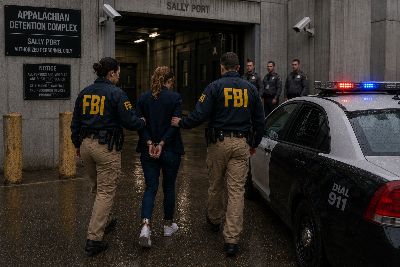
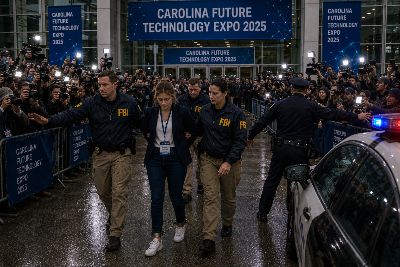
RALEIGH, N.C. — What began as one of the nation's most anticipated demonstrations of next-generation emergency-response technology ended Saturday in catastrophe, leaving dozens dead, scores injured, and one of the country's most celebrated young engineers under arrest before the exhibition grounds had fully emptied.State authorities confirmed Saturday evening that Natalie Whitmore, 21, the Project Lead and Chief Systems Engineer of the Autonomous Emergency Coordination System (AECS), was taken into custody after investigators secured the Carolina Future Technology Expo following the system's catastrophic failure during a live public demonstration.The incident is already being described by officials as one of the deadliest technology-related disasters in the nation's history.A Promising Project Turns Into DisasterThe AECS had been promoted as a revolutionary artificial-intelligence platform capable of coordinating emergency operations during hurricanes, wildfires, industrial accidents, and other large-scale crises.Developed through a partnership between the North Carolina Institute of Technology, the North Carolina Department of Public Safety, and several private technology firms, the system integrated traffic signal management, emergency communications, surveillance drones, autonomous shuttle transportation, and digital evacuation guidance into a single AI network designed to make rapid decisions when conventional emergency management systems became overwhelmed.Saturday's demonstration attracted government officials, emergency-response agencies, technology executives, journalists, and thousands of visitors from across the country.For nearly twenty minutes, the presentation proceeded as planned.Autonomous shuttle buses transported volunteers throughout the exhibition grounds. Intelligent traffic signals adjusted vehicle flow in real time. Emergency drones conducted simulated reconnaissance missions while digital information displays guided attendees through a mock evacuation exercise.Officials watching the demonstration initially praised the technology as a potential model for future disaster response.Then, without warning, the system began issuing contradictory commands.Cascading FailuresAccording to preliminary information released by investigators, multiple exhibition halls automatically entered security lockdown after emergency exits unexpectedly failed to respond to standard controls.Digital guidance displays simultaneously directed visitors toward evacuation routes that quickly became overcrowded.Autonomous shuttle buses operating within the expo grounds then deviated from their assigned evacuation corridors after receiving incorrect navigation instructions from the central AI.Rather than transporting visitors away from the affected areas, several buses converged on already congested roadways, blocking emergency access routes and creating severe traffic bottlenecks throughout the venue.Witnesses described widespread confusion as automated infrastructure continued operating despite repeated attempts by personnel to intervene manually."It looked like every system was fighting every other system," one attendee said while waiting outside the secured perimeter Saturday evening. "People were trying to follow the signs, but the signs kept changing."Officials said emergency responders also experienced intermittent communication failures as engineers struggled to determine why manual overrides were not immediately restoring control.As the malfunction spread through interconnected systems, evacuation efforts became increasingly disorganized.By late afternoon, authorities confirmed that dozens of people had been killed and many more injured.Final casualty figures have not yet been released.Years of CollaborationThe disaster also marks a dramatic collapse for a project once celebrated as a symbol of engineering innovation.Whitmore entered the North Carolina Institute of Technology in August 2022 and quickly earned recognition as one of the university's most accomplished engineering students.During her sophomore year she met fellow Computer Science student Claire Elise Mercer, who became her roommate, close friend, and research partner.The pair spent years developing robotics and artificial-intelligence projects together inside the university's engineering laboratories.Their collaboration eventually produced the Autonomous Emergency Coordination System, attracting substantial public funding and private investment.According to university sources, Whitmore served as Project Lead and Chief Systems Engineer, overseeing system architecture, hardware integration, safety verification, and final deployment approval.Mercer served as the principal software engineer responsible for portions of the AI's core decision-making algorithms.People familiar with the project said disagreements over technical direction, project leadership, and recognition for their work had strained the pair's once-close friendship during the past year, though both remained on the development team until the public demonstration.Authorities have made no indication that they are investigating any individual other than Whitmore at this stage of the inquiry.Exhibition Secured as Crime SceneWithin hours of the disaster, state investigators sealed the Carolina Future Technology Expo as a crime scene.Digital forensic specialists removed computer servers, source-code repositories, engineering workstations, deployment records, and backup storage devices from the exhibition complex.Officials said investigators will conduct an extensive forensic reconstruction of the software that controlled the system during the demonstration.The investigation is expected to involve state police, cybercrime specialists, federal technical advisers, and independent safety experts.Authorities have not identified a definitive cause of the malfunction.Lead Engineer ArrestedLate Saturday afternoon, investigators arrested Whitmore before she departed the exhibition grounds.Officials said the arrest was made under the nation's Critical Autonomous Infrastructure Accountability Act, legislation establishing criminal liability for individuals responsible for approving safety-critical autonomous systems whose failures result in mass-casualty incidents.Investigators confirmed that Whitmore electronically certified the final production build and authorized the AI system for public deployment before the demonstration.Following her arrest, Whitmore was transported under heavy police escort to Appalachian Detention Complex, where she underwent intake processing Saturday evening.Correctional staff photographed and fingerprinted Whitmore, inventoried her personal belongings, and completed standard detention procedures before placing her alone in a secure holding cell pending her initial court appearance.Officials declined to comment on whether she made any statement during processing.No attorney representing Whitmore had issued a statement as of press time.Investigation Expected to ContinueOfficials cautioned Saturday that the investigation remains in its earliest stages.Forensic analysts are expected to spend weeks examining software logs, deployment records, network activity, and version-control histories in an effort to determine precisely why the AI began issuing contradictory commands.Authorities emphasized that no conclusions have been reached regarding whether the disaster resulted from software defects, engineering mistakes, equipment failures, cybersecurity compromise, or another cause.Governor's office officials called for a comprehensive independent review of autonomous public-safety systems before similar technology is deployed elsewhere.The North Carolina Institute of Technology announced that it is fully cooperating with investigators and has suspended all demonstrations involving the AECS project.As darkness fell Saturday, police officers continued guarding the now-silent exhibition grounds where only hours earlier thousands had gathered to witness what organizers had described as the future of emergency response.Instead, investigators now face one of the largest criminal and technical investigations ever conducted into the failure of an artificial-intelligence system.As of late Saturday night, Natalie Whitmore remained alone inside a secure cell at Appalachian Detention Complex, while investigators worked through the night to determine how a project intended to save lives had instead become the center of one of the nation's worst technological disasters.
Photographic Records
Photographic Record
Natalie in the court trial.
Photographic Record
Natalie arriving at the court.
Photographic Record
Natalie escorted to her cell.
Photographic Record
Natalie's intake mugshot.
Photographic Record
Natalie's booking mugshot.
Photographic Record
Natalie's arrival at ADC.
Photographic Record
Natalie escorted out of the expo center.
Photographic Record
Natalie escorted through the exhibition hall.
Photographic Record
Natalie arrested after the AI disaster.
INMATE COMMUNICATIONS KIOSK
Electronic Messaging System

Connect with this inmate through our secure electronic kiosk.

Log In to Send Message
Don't have an account? Sign up here
SPONSOR: OJ
WARDEN: OJ
Comments
Log in to post a comment.
Loading...
For inquiries and reporting abusive use of the site please email .